

The U.S. Is One of the Cheapest Countries in the World to Employ Someone, New Global Index of 192 Countries Finds
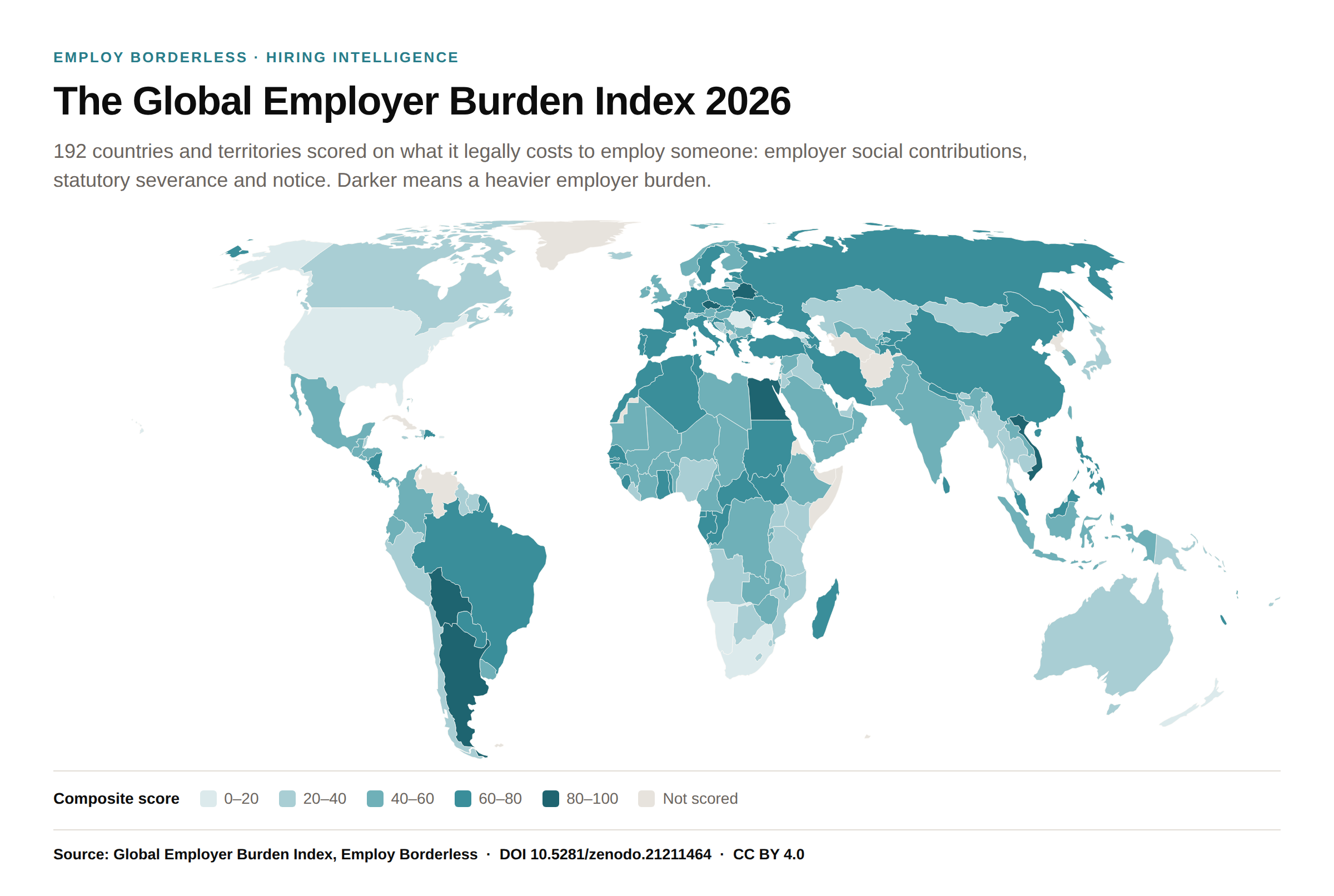
Map from the Global Employer Burden Index, Employ Borderless: 192 countries and territories shaded by statutory employer burden, darker meaning heavier. DOI 10.5281/zenodo.21211464.

What a $50,000 hire really costs by law: about $54,000 in the US, $56,800 in the UK, $60,400 in Germany, $68,200 in France and $69,500 in Argentina. Source: Global Employer Burden Index, Employ Borderless.

The heaviest and lightest places to employ in 2026: Argentina ranks 1st, the UK 85th, the US 158th and New Zealand 163rd of 192. Source: Global Employer Burden Index, Employ Borderless.
The US ranks 158th of 192 countries by the legal cost of employing someone, among the world's lightest. Global Employer Burden Index, Employ Borderless.
The index measures the statutory cost and obligations employers face when hiring across 192 countries and territories. It helps employers compare hiring costs using transparent, sourced legal data rather than salary alone. The full rankings, pillar scores, and sourced statutory inputs are published as open data and permanently archived with a DOI.
The index evaluates each country using three statutory pillars:
* Employer social security contributions (50%)
* Statutory severance (30%)
* Statutory notice periods (20%)
Each pillar is ranked against every other scored country and combined into a composite score from 0 to 100, where a higher score represents a heavier statutory employer burden.
Countries are included only when approved, sourced values are available for all three pillars. Where data is unavailable, countries are listed as excluded rather than estimated. The index contains no estimates and no AI-generated data.
Where the United States Ranks
The United States ranks 158th out of 192 countries, making it the lightest statutory employer burden among the G7 economies.
The U.S. has:
* No federal statutory severance requirement
* No statutory notice requirement
* Employer social security contributions of approximately 8%
As a result, it is one of the least expensive countries in the world to employ someone from a statutory perspective, despite relatively high wages and overall labour costs.
The impact becomes clear when comparing a single employee earning a $50,000 annual salary:
* United States: approximately $54,000
* United Kingdom: approximately $56,800
* Germany: approximately $60,400
* France: approximately $68,200
* Argentina: approximately $69,500 (the highest employer burden)
Each figure represents the base salary plus any mandatory 13th-month salary where legally required, multiplied by statutory employer contribution rates. Contribution ceilings and other statutory obligations are not included. The differences are driven solely by legal employer obligations before benefits or market compensation are considered.
Global Findings
Argentina records the highest statutory employer burden of any scored country, followed by Belarus, Czechia, Vietnam, and Egypt. At the opposite end of the ranking, New Zealand has the lightest statutory employer burden.
Across the index:
* 38 countries and territories have no statutory severance requirements, meaning termination costs depend primarily on notice periods, employment contracts, and negotiation rather than mandatory severance payments.
* 58 countries and territories are excluded from scoring because one or more statutory pillars could not be supported by reliable source data. Rather than estimating missing values, these jurisdictions are transparently listed as excluded.
The complete dataset is available in both CSV and JSON formats. Every value includes its source and publication date, and the data may be quoted or republished with attribution under the Creative Commons Attribution 4.0 License.
The dataset is permanently archived on Zenodo under DOI 10.5281/zenodo.21211464.
Explore the index and download the data at:
employborderless.com/hiring-intelligence/employer-burden-index/
About Employ Borderless
Employ Borderless is an independent advisory platform for global hiring. It helps companies compare employer of record (EOR) and global payroll providers while providing transparent, sourced research into the statutory cost of employing workers around the world. The Global Employer Burden Index forms part of the company’s open hiring intelligence research.
Media Contact
Robbin Schuchmann
Employ Borderless
robbin@employborderless.com
ROBBIN SCHUCHMANN
Employ Borderless PTE. LTD.
+31 6 14514284
email us here
Visit us on social media:
LinkedIn
Instagram
Facebook
YouTube
X
Other
Legal Disclaimer:
EIN Presswire provides this news content "as is" without warranty of any kind. We do not accept any responsibility or liability for the accuracy, content, images, videos, licenses, completeness, legality, or reliability of the information contained in this article. If you have any complaints or copyright issues related to this article, kindly contact the author above.
